The Council of Ministers has approved the draft bill modifying the 1995 Occupational Risk Prevention Law (Ley de Prevención de Riesgos Laborales), a regulation that had gone over 30 years without a structural update. This initiative represents a comprehensive overhaul of Spain’s preventive model, incorporating new dimensions of risk linked to mental health, digitalization, and changes in work organization.
According to data presented by the Ministry of Labor, over 700 people died in their workplace in 2025, while professional illnesses rose to 30,713.
Based on information published following the approval, the reform aims to modernize the preventive system and adapt it to a labor environment profoundly transformed by technology, remote work, and the increase in psychosocial risks, in addition to strengthening protection against climate phenomena and new forms of production management.
The reform is currently in the draft phase and must continue its parliamentary process before final approval. However, it already anticipates a significant shift in how organizations manage prevention.
The New Paradigm for HR: Evaluation, Data, Prevention, and Decision-Making
This new regulatory framework reinforces the role of Human Resources as a key agent in prevention. Risk management is no longer a one-off exercise but a continuous process of monitoring, analysis, and action (Ministry of Labor and Social Economy, 2026; Law 31/1995 on Occupational Risk Prevention).
Prevention is no longer limited to completing an annual evaluation or a standard protocol. The new context will require the ability to identify patterns, anticipate risks, and act on organizational variables that directly impact well-being and performance (European Agency for Safety and Health at Work, EU-OSHA, 2023).
In this scenario, data quality becomes a central element. Without information on climate, engagement, workload, or environmental perception, prevention loses its predictive power and becomes merely reactive.
How we do it at Hrider: Psychosocial Risk Prevention through Talent Management
Undoubtedly, people management has taken on a decisive role in preventing psychosocial risks. Factors influencing occupational health—such as workload, leadership quality, internal climate perception, or recognition levels—are not detected in isolated audits, but in the constant evolution of organizational data.
The reform of the Occupational Risk Prevention Law reinforces the obligation to integrate psychosocial risks into preventive evaluations using validated methodologies. At Hrider, we use COPSOQ-ISTAS21 as the methodological foundation for psychosocial risk assessment, integrating it into a solution that facilitates its application in a structured, agile way, adapted to various organizational sizes and sectors.
All information is centralized on a single platform, facilitating comprehensive prevention management and eliminating the need for scattered tools. The process is conducted anonymously, encouraging participation and obtaining more representative responses. Furthermore, the solution allows working with different versions of the COPSOQ questionnaire based on the company's needs, adjusting the depth level of the evaluation.
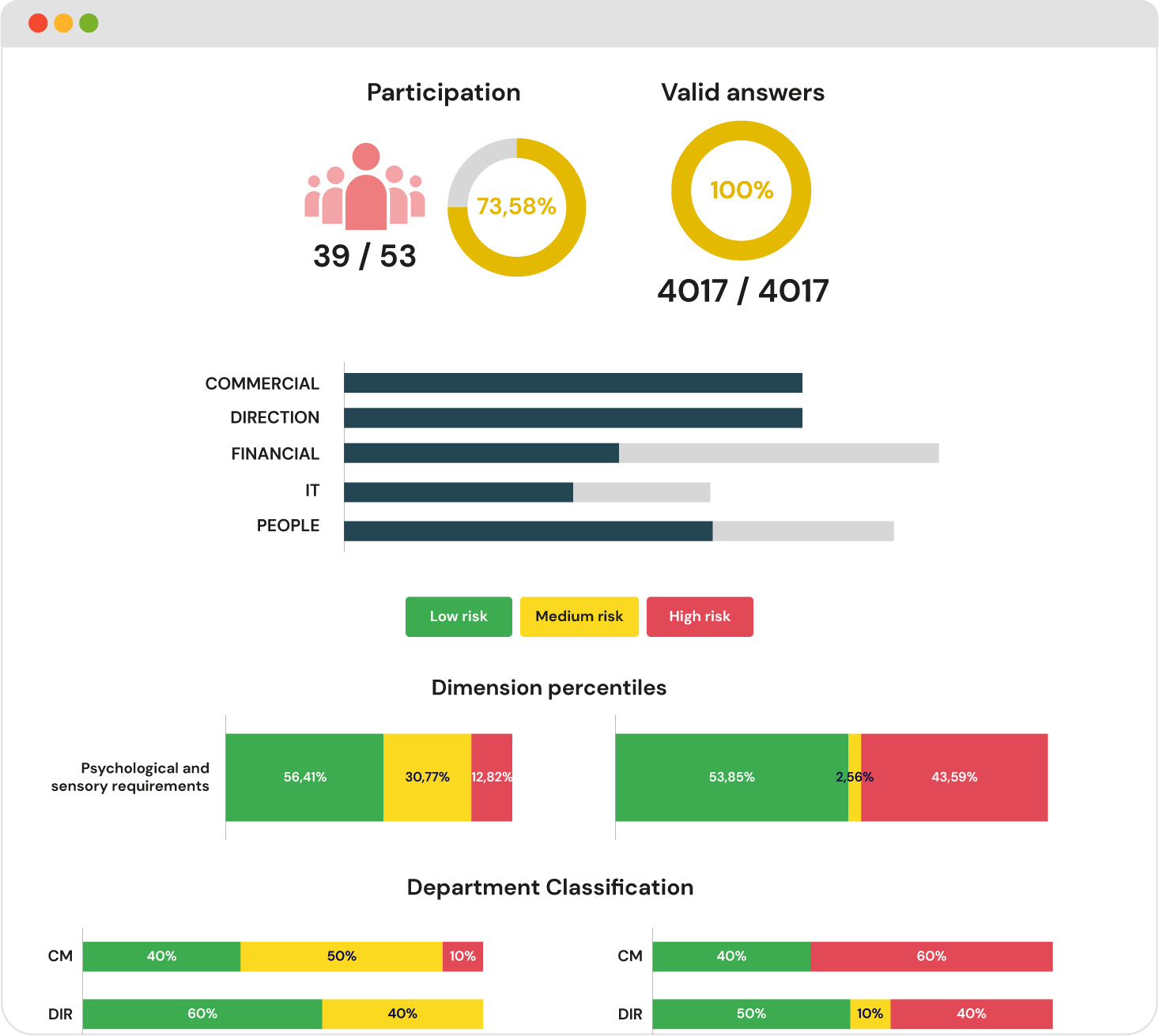
The Hrider approach places the employee at the center of the evaluation process, fostering greater participation and improving the quality of the information gathered. This is particularly relevant in measuring psychosocial risks, where people's perception is a critical element for obtaining reliable diagnoses. Additionally, the platform incorporates advanced real-time analytics, allowing for the segmentation of information by organizational and sociodemographic variables, as well as applying Artificial Intelligence to analyze open-ended comments, identifying relevant patterns and insights for decision-making.
In this new regulatory framework, the combination of COPSOQ-ISTAS21 and Hrider allows organizations not only to comply with the Occupational Risk Prevention Law but also to evolve toward a more mature, data-driven prevention model.
If you want to take the next step in psychosocial risk assessment and turn regulatory compliance into real organizational well-being management, you can learn more about our approach at Hrider.