back to dictionary
Y axis

What do we mean by potential?
Potential refers not to current performance, but to a person's ability to take on greater responsibilities in the future. It can include aspects such as:
- Learning ability.
- Adaptability to change.
- Leadership skills.
- Strategic thinking.
- Agility to develop in new roles.
Therefore, evaluating potential requires a more predictive than descriptive perspective.
In a practical example using a 9-Box matrix, you would use:
- X-axis (horizontal) represents performance.
- Y-axis (vertical) represents potential.
An employee positioned at the top of the Y-axis demonstrates high potential, indicating strong capacity to take on more complex roles, potential for medium- or long-term promotion, as well as high adaptability to new challenges.
On the other hand, lower positions on the Y-axis reflect more limited potential in terms of future growth, without necessarily implying low current performance.
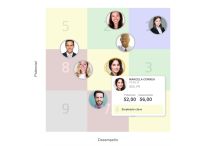
Building a Nine Box Talent Matrix has never been easier. With Hrider's N-Box functionality, you can create 9-box matrices as well as 4-, 16-, and 25-quadrant matrices that correlate different variables such as performance and potential. In this tutorial you will learn what they are and how to easily create them step by step.